A striking vehicle concept sketch is easy to admire and surprisingly hard to build. Behind every dramatic silhouette or bold render lies a long, disciplined process of translating imagination into something that can actually be manufactured, tested, and driven. This is the real work of an automotive design studio, not just imagining what a vehicle could look like, but methodically shaping that idea into a functioning, physical prototype without losing what made the concept compelling in the first place.
Understanding this journey, from a rough sketch to a tangible model, reveals just how much engineering discipline sits beneath every polished concept reveal.
It Starts With Intent, Not Aesthetics
Contrary to popular belief, the design process rarely begins with styling. It begins with a clear understanding of purpose: who the vehicle is for, what problem it solves, and what constraints- regulatory, mechanical, budgetary- will shape every decision that follows. Designers and engineers work closely together at this stage, because a beautiful form that ignores structural or manufacturing realities will never survive the transition from sketch to prototype.
This early alignment between form and function sets the tone for everything downstream. Skipping it, or treating it as a formality, is one of the most common reasons ambitious concepts stall before they ever reach a physical stage.
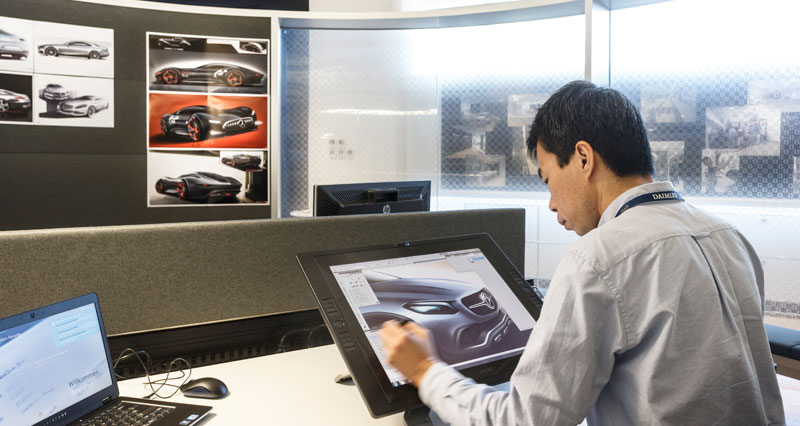
Sketching and Digital Modeling: Exploring Form at Speed
Once the brief is clear, designers move into rapid ideation, sketching dozens, sometimes hundreds, of variations to explore proportion, stance, and character. These sketches aren’t meant to be final; they’re a way of quickly testing ideas before committing resources to anything more detailed.
The strongest directions are then rebuilt digitally using 3D modeling software, where surfaces can be refined with precision that hand sketches can’t offer. This stage allows designers to evaluate how light plays across a surface, how panel gaps align, and how proportions hold up from every angle, long before a single physical part exists.
Engineering Reality Enters the Picture
As the digital model matures, engineers begin layering in the practical requirements that will determine whether the design can actually be built. Structural feasibility, material selection, mechanism placement, and manufacturing constraints all get evaluated against the design intent.
This is often where compromises happen, not because the original vision was flawed, but because turning a concept into something drivable demands trade-offs between ambition and buildability. Good studios treat this stage as collaborative rather than adversarial. Engineers and designers negotiate constantly, refining details until the design holds onto its identity while becoming genuinely production-feasible.
From Digital Model to Physical Form
This is where product prototyping services become central to the process. A digital model, however refined, can’t reveal everything. Physical prototypes expose issues that only become obvious once you can walk around a model, sit inside it, or run a hand along its surface — proportions that look right on screen but feel off in person, or ergonomic details that need adjusting once scale becomes real.
Depending on the stage and purpose, prototypes range from simple foam or clay models used for early proportion studies, to detailed 3D-printed or CNC-machined mockups used to validate surfacing, panel fit, and interior packaging. Each iteration answers specific questions, and each round of feedback feeds back into the digital model for refinement.
Testing, Iteration, and Refinement
A prototype is not the finish line. It is a checkpoint that reveals what needs to change before the design moves further. Automotive studios typically work through several rounds of evaluation:
- Build and Evaluate
The physical prototype is examined for design accuracy, usability, proportions, functionality, and overall execution. - Gather Feedback
Input from engineers, stakeholders, designers, or user research helps identify issues that may not have been visible during digital development. - Refine the Design
Based on those findings, specific elements are adjusted. Changes may involve form, ergonomics, materials, functionality, or technical feasibility. - Prototype Again
The revised concept is turned into another physical model and evaluated against the earlier version. - Validate the Outcome
The process continues until the design achieves an effective balance between visual appeal, functional requirements, and practical buildability.
This repeated cycle is where an automotive design studio demonstrates its real depth. Creating an exciting concept is only the beginning; preserving its original character while resolving practical challenges through multiple rounds of testing requires both creative judgement and engineering discipline.
Bridging to Production
Once a prototype is validated, the final stretch involves preparing the design for manufacturing, finalizing production-ready files, coordinating with vendors, defining tooling requirements, and setting up quality checks that ensure consistency at scale. This handoff stage requires just as much precision as the earlier creative work, since even small oversights here can create costly problems once production begins.
Studios that manage this transition well don’t treat prototyping as the end of the design process; they treat it as the bridge that connects a validated concept to a manufacturable product, carrying the original intent through every stage without dilution.
Final Thought
Turning a vehicle concept into a working prototype is rarely a straight line; it’s a cycle of sketching, digital modeling, engineering validation, and physical testing that gradually shapes an idea into something real. Every round of feedback sharpens the design further, ensuring the final result stays true to its original vision while remaining genuinely buildable. Reliable product prototyping services make this entire process possible, giving teams the physical clarity that digital models alone simply can’t provide, and ultimately determining whether a bold concept becomes a vehicle people can actually drive.
Studio 701 approaches automotive development with a focus on turning early concepts into practical design outcomes. Its work connects creative design thinking with engineering and prototyping considerations, helping teams examine ideas beyond the digital screen. This approach supports better-informed decisions as vehicle concepts move through refinement and development.