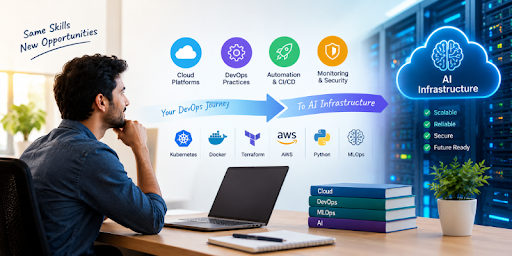
AI is transforming the application development, deployment and management landscape. With the increasingly prevalent use of AI workloads, enterprises must have the infrastructure to support the massive volumes of data, compute, and frequent deployments. It makes for an intriguing career trajectory for existing Cloud and DevOps engineers with an existing background in automation, cloud platforms, monitoring, and infrastructure management.
The journey into AI infrastructure doesn’t have to be a zero sum game. A lot of the current devops skills can be directly transferred to an AI environment.
What are the Value of DevOps Skills to AI Infrastructure?
Scalability, reliability, security, and maintenance are critical requirements for AI infrastructure. These are places where there is an existing real-world experience in DevOps.
Some of the major transferable skills are:
- Cloud infrastructure management
- CI/CD pipeline development
- Infrastructure as Code
- Containerization and orchestration
- Monitoring and logging
- Automation and deployment
- Security and access management
For instance, individuals who have completed DevOps Training in Chennai can leverage their expertise in deployment automation and cloud platforms, while discovering the infrastructure needs for AI applications.
Which are the New Skills that DevOps Engineers need to Learn?
While DevOps is a solid foundation, AI infrastructure encompasses some other concepts. Engineers need to be gradually introduced to the training, deployment, monitoring, and updating of machine learning models.
There are some interesting resources to investigate, such as:
- Machine learning fundamentals
- Model deployment
- MLOps concepts
- GPU-based computing
- Data pipelines
- Model monitoring
- AI workload orchestration
aws and devops together can be beneficial, as the cloud offers a range of services for handling computing, storage, networking, containers, and AI workloads. While the DevOps engineer doesn’t necessarily have to be a data scientist, it helps to understand how AI systems work to make infrastructure decisions easier.
So what is the Relationship Between MLOps and DevOps?
In the machine learning lifecycle, MLOps incorporates DevOps concepts. In addition to application code, engineers must also take into account datasets, models, experiments, and model versions.
Some of the activities involved in devops lifecycle—development, testing, deployment, monitoring, and continuous improvement—are already covered in the lifecycle. Similar practices are applied to machine learning workflows with MLOps.
This may be helpful to professionals pursuing DevOps Training in Bangalore as today, many tech teams are integrating cloud automation, software delivery and machine learning operations in the same infrastructure.
What Tools Can Help With the Transition?
One approach that engineers can take is to familiarize themselves with the technologies that are widely adopted in the current AI infrastructure.
These may include:
- Docker and Kubernetes
- Terraform
- Use either GitHub Actions or Jenkins.
- Cloud platforms
- Python basics
- MLflow
- Monitoring platforms
- Data pipeline tools
It’s not about learning all the technologies at once. A useful way to do this is to know how these tools work together to get an AI model from development to a reliable production environment.
DevOps Training in Hyderabad can be beneficial for professionals who are building their cloud automation expertise, as they can get a head start in learning the concepts of deployment, containers, infrastructure automation, and so on, which can be directly used for AI workloads.
Are DevOps Engineers Capable of Creating AI Infrastructure Projects?
Yes. One of the best ways to learn about the transition is through hands-on projects.
A basic project might be to develop a pipeline that:
- Collects and prepares data.
- Trains machine learning model.
- Packages the application in a Docker container.
- Installs and configures it in a cloud environment.
- Monitors its performance.
- Automatically updates the deployment as needed.
Such initiatives highlight the potential for integrating current DevOps principles into AI systems and for educating engineers about MLOps.
For professionals aiming to deepen their hands-on DevOps expertise, there are opportunities for DevOps Training in Gurgaon, as well as developing projects that integrate cloud automation with the latest in AI infrastructure.
What is Cloud & DevOps Engineers Future?
The impact of AI infrastructure is likely to generate new opportunities for engineers to bridge the gap between cloud, automation, and machine learning. Many of the fundamental skills associated with managing complex infrastructure are already in place and familiar to devops professionals, making it more approachable.
AI is not about to supplant the need for DevOps knowledge, but it’s an additional field where DevOps knowledge can be applied. Cloud and DevOps engineers can leverage this additional expertise in MLOps, AI deployment, cloud, and automation and find new opportunities and careers in AI infrastructure.