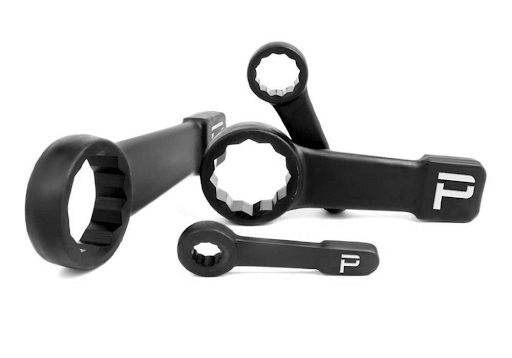
Ask a maintenance fitter in any Indian plant what’s in their tool bag, and an adjustable spanner will almost always come up first. It’s cheap, light and fits most nuts. But during a turbine or pump overhaul, there’s one job it simply can’t do. Slotted round nuts need a castellated wrench.
Mixing these two up costs time. On a planned shutdown of 10 or 12 days, even one lost shift hurts. So it helps to know which tool a job needs before the work starts.
A Slotted Round Nut Always Needs a Castellated Wrench
Look at the nut before you pick up any tool. If it’s round, with notches cut into the outer edge or the face, put the spanner away. Its jaws need flat sides to grip, and a round nut has none.
A castellated wrench has lugs that sit inside those notches. The turning force spreads across several slots at once, so the nut doesn’t get chewed up, even when it’s been tight for years.
Jobs Where You’ll Need One
- turbine coupling and casing nuts in thermal and hydro plants
- bearing lock nuts on large pumps, fans and motors
- gland nuts and heavy shaft nuts in cement and steel plants
Three Measurements to Take Before Ordering
Before ordering, check that the wrench matches the nut in three ways: the number of slots, the width of each slot and the nut’s outside diameter. You can take these readings during a shutdown or get them from the OEM drawing. Note them down in the maintenance file, so next time the right wrench is ready on day one.
An Adjustable Spanner Works Best on Small, Everyday Nuts
For small and medium hex nuts, an adjustable spanner means you don’t have to carry a full set. A single 12-inch spanner covers pipe fittings, valve flanges and panel bolts, jobs that would otherwise need several fixed spanners.
It does have limits, though. The moving jaw has a little play, and under heavy force it can slip and round off the corners of a nut. Honestly, a lot of damaged nuts in plants come from someone putting a long pipe on an adjustable spanner to “just get it moving”.
Simple Habits That Help
- Close the jaw tight on the nut every single time.
- Pull so the force goes toward the fixed jaw.
- Don’t hit it with a hammer. It isn’t built for that.
- Wipe the worm screw and add a drop of oil once a month so it doesn’t jam.
If a nut still won’t budge with normal force, don’t push your luck. It’s usually telling you to switch to a proper fixed wrench, a slugging wrench or a castellated one.
Conclusion
Use an adjustable spanner for light work on normal hex nuts. For the slotted round nuts on turbines and heavy machines, use a castellated wrench made for that nut size.
POWERMASTER, based in Navi Mumbai and ISO 9001:2015 certified, makes castellated wrenches for GE turbines. Its tools go to customers in more than 120 countries.