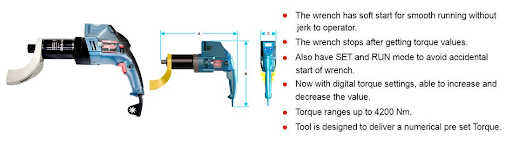
The choice of an electric powered torque wrench is dependent on the intended application. It is advisable to look at the torque level needed, size of the fastener and square drive, power source, working environment, torque reproducibility, and need for a torque reaction arm. The appropriate tool would be one that fits the joint design and work environment as opposed to offering the highest torque capacity possible.
1. Flange Bolting in Industrial Piping
Flange joints require careful tightening for proper functioning. An electric torque wrench can help when you need to tighten many flanges to a specific torque level.
It provides preset torque, allowing the user to set the required torque. The wrench tightens to the set torque and then stops.
2. Heavy Equipment Maintenance
Large industrial equipment requires fasteners that need high torque. Manual tightening of such fasteners may require a lot of energy, especially when maintenance is required.
Electric torque wrenches are torque tools used in applications where high torque is required. Controlled use of electric torque wrenches makes it appropriate for use by:
- Heavy machinery
- Industrial machinery
- Large mechanical assemblies
- High torque applications
3. Industrial Assembly With Repeated Fastening
When dealing with assemblies with several bolts that require a similar torque, the concept of repeatability plays a critical role. This is because an electric torque wrench lets the operator preset the desired torque instead of setting it repeatedly.
Use of digital torque setting with the display of the set torque is one way to ensure that the operator adheres to the preset torque during the entire process.
4. Plant Maintenance and Shutdown Work
Maintenance work and shutdown can involve many fasteners across several pieces of equipment or machinery. Setting the torque ahead of time ensures that the task is done in an organized manner and cuts down the effort needed for higher torque.
Non-impact action of the electric torque wrench also comes handy where smooth turning is desired. The soft start feature makes it run smoothly and prevents any jolt at the beginning of its operation.
5. High-Torque Industrial Fastening
Some bolting processes require much higher amount of torque compared to what a traditional hand torque wrench would be able to provide. Selecting a suitable electric torque wrench will help the torque wrench adapt to the fastening needs.
The torque ranges for the electric torque wrenches are different, starting from 150 Nm up to 4,200 Nm.
6. Bolting Jobs Requiring Consistent Torque
Consistency is necessary when there are multiple fasteners contributing to the formation of the joint. Unequal torque readings could influence the load applied to the joint. Therefore, controlled torqueing plays an essential role in industrial settings.
An electric torque wrench makes it possible for operators to focus on the numerical value of the torque rather than only on the force applied. In cases where hydraulic torque wrenches are better suited, hydraulic torque wrench suppliers can help.
Conclusion
Selecting the correct electric torque wrench depends on the application. Consider torque capacity, fastener size, square drive size, power source, available working area, torque repeatability, and reaction arm specifications. The correct tool should suit the joint condition and the working environment, not just have the maximum torque capacity. Bolting Systems offers a range of tools, including electric, hydraulic, and pneumatic options, making it a reliable choice when comparing hydraulic torque wrench suppliers.