The reprint bill was what finally did it.
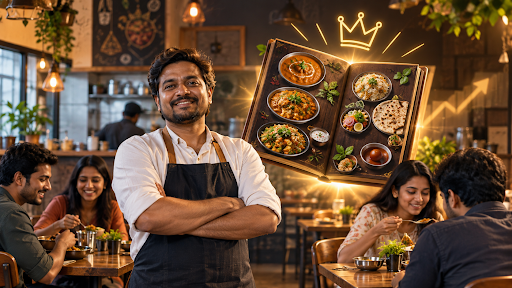
A café owner I know had just paid for her fourth menu reprint in fourteen months. Coffee prices moved. Then the supplier for her bakery items changed. Then she dropped two dishes nobody ordered and added a breakfast plate. Every single time: new design file, new print run, forty-eight laminated cards, and a two-day wait during which the servers had to verbally apologise for the wrong prices printed in front of the customer.
Forty-eight cards. Four times. For a twelve-table café.
She switched to a scannable menu in an afternoon, and she has not printed a menu since.
What a QR code menu actually is
A QR code menu is a printed square that links to a web page or PDF holding your food list. The customer points a phone camera at it, the menu opens, and that is the whole interaction. Nothing gets downloaded, no app is required, and on every phone sold in the last several years the camera app reads it natively without any extra software.
What matters underneath is boring but important: the code points at a URL, and the URL points at a file you control. Change the file, and every printed code in the room now shows the new menu. The square on the table never has to change.
That single detail is why the reprint problem disappears.
Setting one up without hiring anyone
Most owners assume this needs a developer or a monthly subscription. It doesn’t, and honestly the subscriptions are where a lot of small restaurants overpay.
Here is the actual sequence. Put your menu somewhere with a permanent web address. A page on your own site is best. A Google Drive PDF set to public viewing works. Even a Google Doc will do if you are testing the idea before committing. Copy that address, drop it into a QR code generator online, and download the resulting image at the highest resolution offered. Print it. Stick it on the table.
That is it. That is the entire technical process, and it takes less time than writing one week’s staff roster.
The mistake people make is at step one, not step three. They generate a code that points at a file they later move, rename, or delete, and every printed code in the restaurant goes dead at once. Pick the destination carefully, then never move it.
Why the format works better than an app
Restaurants tried apps around 2016 and mostly abandoned them, for a reason worth remembering: a customer sitting down for a forty-minute lunch will not install software for it. Ever. The friction is enormous compared to the payoff.
A scan asks for nothing. No install, no account, no password, no notification permission. The gap between “customer looks at the table” and “customer is reading your menu” is roughly four seconds.
And there is a quieter benefit. A digital menu can be as long as it needs to be. Printed menus get compressed because paper costs money, so descriptions get cut to three words and the story behind a dish disappears. Online, you can write the full description, list the allergens properly, note which items are vegetarian, and add a photograph of the plate. Guests order more confidently when they can see what is coming.
The parts nobody warns you about
Test the code from an old phone before you print fifty of them. Not your phone. Your phone is new. Borrow a five-year-old handset from a staff member and check that the page loads on a weak connection, because that is the realistic condition inside a stone-walled restaurant at 8pm.
Keep a few paper copies. Some guests genuinely dislike scanning, some phones are dead by dinner, and arguing with a customer about it is a terrible way to start a meal. Six laminated copies behind the counter solves this permanently.
Make the printed square big enough. Anything smaller than roughly three centimetres on a table tent starts failing in dim light. Bigger is free. Use bigger.
And put a line of text under the code telling people what it is. “Scan for our menu” costs you nothing and removes the hesitation of guests who have been trained to distrust random codes in public places.
What it actually saves
The café I mentioned ran the numbers after eight months. Printing: gone. Reprints for seasonal specials: gone. The staff time spent explaining unavailable dishes: mostly gone, because she now greys out sold-out items at 4pm from her phone.
She also found something she wasn’t looking for. Because the menu now lives on her own website, people searching for the restaurant started landing on the actual food list instead of an outdated aggregator listing. Her site traffic roughly doubled. Not from the codes on the tables. From Google finding a page that finally existed.
That was the accident, and it turned out to be worth more than the printing savings.
If you want to test the idea this week without spending anything, put your current menu on a public link, generate a QR code for it, and print exactly two table tents. Watch what happens over three services. You will know very quickly whether your guests take to it.
Most do. Faster than owners expect.
FAQ
Do customers need an app to scan a QR code menu? No. Every current iPhone and Android phone reads QR codes through the built-in camera app. The customer opens the camera, points it at the code, and taps the link that appears.
Can I change the menu after the codes are printed? Yes, as long as the code points to a web page or file you control. Edit the destination and every printed code updates instantly. The code image itself never needs reprinting.
How much does a QR code menu cost? Generating the code is free. Your only real costs are printing the table tents and, optionally, hosting the menu page on your own website.
What size should the printed code be? At least three centimetres square for table use, and larger for wall posters or window displays. Leave a clear white border around it so the scanner can find the edges.
Is a PDF menu good enough? It works, but a mobile-friendly web page is better. PDFs force pinching and zooming on small screens, which frustrates guests more than most owners realise.