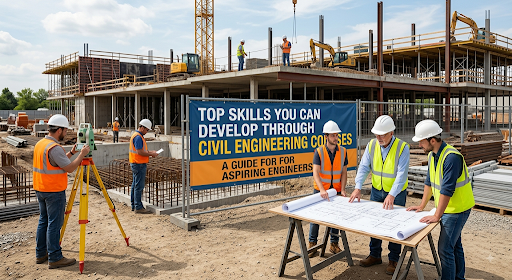
The built environment is evolving rapidly, and today’s civil engineers need more than textbook knowledge to contribute effectively to real-world projects. From analysing structures to interpreting technical drawings, professionals must combine engineering fundamentals with practical, digital, and problem-solving abilities. Well-designed civil engineering courses can help students and working professionals bridge the gap between academic concepts and industry expectations. With structured learning, practical assignments, and exposure to modern design practices, learners can build capabilities that support long-term professional growth.
Structural Analysis and Design Skills
A strong understanding of structural behaviour is one of the most important abilities for anyone pursuing a career in civil engineering. Learners can develop the ability to assess how buildings and other structures respond to different loads, forces, and environmental conditions.
Training can introduce concepts such as load calculations, structural modelling, member design, stability, and design-code applications. More importantly, students learn how theoretical principles influence practical design decisions. This knowledge enables them to approach structural problems systematically while maintaining safety and efficiency.
Proficiency in Engineering Software
Modern construction and structural design rely heavily on specialised software. Developing proficiency in relevant digital tools can therefore give aspiring engineers a significant professional advantage. Students can learn how to create models, analyse structures, interpret results, prepare drawings, and make design modifications using industry-relevant applications. Software skills also improve productivity by reducing repetitive manual work and allowing engineers to examine complex structural behaviour more efficiently.
Learning through civil engineering online courses can make this technical exposure more accessible, allowing students to practise software applications from their own location while following structured instruction. When software training is combined with engineering fundamentals, learners gain a more practical understanding of how digital tools support professional decision-making.
Technical Drawing and Detailing
Engineering ideas must eventually be communicated through accurate drawings and technical documentation. Civil engineering training can help learners understand plans, sections, elevations, reinforcement detailing, and other forms of technical representation. This skill is particularly valuable because even a technically sound design can create problems if drawings are unclear or incorrectly detailed. Developing attention to dimensions, annotations, reinforcement arrangements, and construction requirements helps engineers communicate effectively with architects, contractors, fabricators, and other project stakeholders.
Analytical and Problem-Solving Abilities
Civil engineering projects rarely present straightforward problems. Engineers frequently need to evaluate alternatives, identify constraints, investigate unexpected results, and determine practical solutions. Courses that incorporate case studies, assignments, and project-based learning can strengthen analytical thinking.
Students learn to break complex problems into manageable components, evaluate available information, and apply engineering principles before reaching a conclusion. This approach also encourages engineers to question results rather than simply accepting software-generated outputs. Such critical thinking is essential for responsible engineering practice.
Understanding of Design Codes and Standards
Safety is fundamental to every engineering project. As a result, civil engineering professionals need to understand the design codes and standards applicable to their work. Professional training can introduce learners to the importance of code provisions while showing how requirements influence calculations, structural dimensions, material selection, detailing, and design checks. This helps students recognise that engineering software is only a tool and that professional judgement remains essential. A strong awareness of standards also encourages disciplined working practices and reduces the likelihood of overlooking important design requirements.
Practical Application of Structural Modelling
Structural modelling is an important bridge between theoretical knowledge and professional design work. Learners can develop skills in creating appropriate models, assigning materials and loads, defining supports, running analyses, and interpreting structural responses. A specialised etabs course can be particularly useful for students interested in building structures because it can provide focused exposure to structural modelling and analysis workflows. The value of such training increases when learners understand why particular modelling decisions are made rather than simply learning which buttons to select.
Project Management and Professional Discipline
Technical expertise alone does not guarantee success on engineering projects. Professionals must also understand deadlines, documentation, coordination, quality control, and communication.
Training projects can help students develop habits such as organising technical information, meeting submission requirements, reviewing their work, and responding to feedback. These experiences can prepare learners for collaborative project environments where engineers work alongside multiple disciplines. Time management is another valuable skill. Engineers often handle several calculations, drawings, revisions, and coordination tasks simultaneously, making organised working practices essential.
Attention to Detail and Quality Awareness
Small errors can have significant consequences in engineering. Developing a careful and methodical approach is therefore an essential part of professional education. Assignments and design exercises can encourage learners to check calculations, review drawings, verify assumptions, and compare analytical results against expected engineering behaviour. Over time, this process develops quality-conscious professionals who understand the importance of accuracy at every stage of design.
Ethical and Responsible Engineering
Engineering decisions can directly influence public safety and the durability of infrastructure. Consequently, professional competence must be accompanied by ethical responsibility. Good training should encourage students to respect design standards, avoid compromising safety for convenience, and understand the professional consequences of poor engineering decisions. Developing this mindset helps future engineers make choices based on sound technical principles rather than shortcuts.
Conclusion
The most effective learning combines technical knowledge with practical application. Students who develop structural analysis, software proficiency, detailing, problem-solving, code awareness, and professional discipline are better prepared to transition from academic learning to engineering practice.
This philosophy is reflected in the approach followed by Civilera, which has evolved from structural consulting into specialised engineering training. Its learning approach draws upon practical consulting experience and focuses on connecting technical concepts with industry-oriented design practices. Their emphasis on responsible engineering, technical competence, and practical learning can help students develop not only software skills but also the professional judgement required in real projects.
Ultimately, choosing the right civil engineering courses can be an important step towards becoming a technically capable, confident, and responsible engineering professional. With consistent practice and guidance, learners can transform classroom knowledge into practical capabilities that support meaningful careers in the construction and structural engineering sector.